Wednesday, January 16, 2008

Tonal Study Project

The compositional language of Mozart and Schubert with reference to their late Quartets


************
Part One: Study
*********

1/ An introduction to the String Quartet during the Classical & Classical-Romantic era


2/ Wolfgang Amadeus Mozart (1756-791)


3/ Franz Schubert (1797-1828)

4/ Similarities and differences in the harmonic language of Mozart and Schubert’s string quartets

5/ Finale

******** Part Two: Tonal exercise *********


6/ A string quartet in the style of Mozart or Schubert Adapted


Index of string quartet output by Mozart and Schubert

Bibliography


Written by Cheng Po Chun @2008


+++++++++++++++

+++++++++++ Other Essay ++++++++++

++++++++

Monday, January 14, 2008

Baroque concerto - Part One

Discuss the contribution of J.S.Bach to the Baroque concerto


Johann Sebastian Bach (1685-1750), the German composer and instrumentalist served as an organist at Arnstadt (1703-7) and Muhlhausen (1707-8); as court organist and later concertmaster in the chapel of the Duke of Weimar (1708-17); and as music director at the court of the Prince of Saxony (1717-23).Prior to his death, his final position was Cantor of St.Thomas’s School and music director in Leipzip (1723-50) (1).

Of all the violin concertos which Bach wrote during his lifetime only three still survived, two (A minor, BWV 1041 and E major, BWV 1042) for solo violin, and one (in D minor, BWV 1043) for two violins (this is often called Bach’s double concerto). The solo works are generally thought to have been composed for the court violinist at Cöthen, Josephus Spiess. Cöthen is a town in Saxony. Bach was for the talented employed as Kapellmeister by the Prince Leopold of Anhalt- Cöthen between 1717 and 1723.

___________________________________
(1) Donald Jay Grout & Claude V.Palisca, A History of Western Music, (5th ed., New York, 1996), p.403

He composed his music to be performed in every week on Sundays (2). Most likely during period of time, Bach wrote his music for religious use.

The seed of the solo concerto grew from the concerto grosso genre which was popular during the Baroque era. It was a single instrument playing alongside and against with the weight of full orchestra. Besides, the composers during this time liked to write a difficult and technical passages for the soloist. In the Baroque period, most of the solo concertos were consisted of three movement, quick : slow : quick. The quick movement was generally in ritornello form (3). According to the Oxford Composer Companions J.S.Bach, ritornello is a passage written for the full complement of instruments (and sometimes voices) that recurs in various guises during the course of a movement. Ritornello, simply means ‘return’.

All Bach’s violin concertos are three-movement works following Vivaldi’s use of the concerto form. Through the concerto, we can see how Bach contributed and introduced new ideas in his music. His violin concertos include the solo concertos A minor and E major and a double violin concerto in D minor. In this essay, I wish to focus on the details of Bach’s solo violin concerto in A minor and E minor have been used for discussion. Details of Vivialdi’s concerto form and Bach’s D minor ‘double’ concerto will not be covered in this essay.

__________________________________
(2) http://www.classicalarchives.com/bios/bach_bio_hl.html (Access dated 22 Dec, 2006)
(3) Roy Bennett, History of Music, (Cambridge, 1987), p.35


Bach uses ritornello form regularly in his concerto. These features clearly show us how much Bach had been inspired by and worked to transform the kind of concerto which Vivaldi wrote before him. Although, all Bach’s violin concertos are three-movement works (following Vivaldi’s use of the concerto form). Bach introduced some new ideas and techniques to enrich the piece. His concertos always emphasise on strong melodic lines over an ostinato bass in the slow movements. Ostinato bass is kind of recurrent bass. This means repeating the use of the same pattern of bass line through a portion of the whole movement. Moreover, Bach enriched the texture of his concertos with thematic accompaniment, counterpoint, interrupting the ritornello with solo passages and chromaticism. These were not often found in Vivaldi’s violin concertos. A brief summary of the structure of Bach’s A minor Violin concerto is shown in following table:


First Movement

The first movement is in ritornello form and in 2/4 time. The key signature changes in every section of this movement and back to the tonic key in the last section. In this movement, the first twenty-four bars dominate the whole movement (4) and the first and second violins play the main theme in unison which is the first Ritornello. Also, the key changes at every ritornello and episode, but returns back to the tonic home key in the final Ritornello.
__________________________________________
(4)Malcolm Boyd, Bach, (New York, 2000)

The detail of the structure of the first movement is shown in following chart (5):


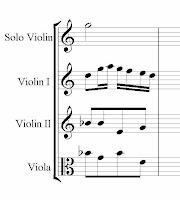
In the opening of a movement from a Vivaldi concerto, it was normally written as a tutti (e.g. Vivaldi’s Four Seasons). Bach used the same composing technique but introduced some ideas of doubling the solo and first violin in unison lasting for twenty-four bars. (See Example 1 below) This little section ends with a change of key to the dominant major of the tonic key. We can see clearly that how Bach announced the main theme in the opening. Besides, the extension of the motivic idea can be seen throughout the entire piece.

Example 1 (First Movement bar 1-9)


____________________________________
(5) Frank Howes, “Johann Sebastian Bach”, The Concerto, ed. by Ralph Hill, (UK, 1966)


The first time it reappears in bar 43-44 (See Example 2 below) from the first movement.


Example 2 (First Movement bar 43-44)


After the end of the opening section, the solo violin comes in and plays the first episode in the key of A minor. In these 27 bars, Bach enriched the texture by means of thematic accompaniment. This means the fragment of motive ideas has been used in accompany parts. (See Example 3 below)

Example 3 (First Movement bar 31-34)


The Ritornello II begins on last quaver beat of bar 51 in the key of C Major. Later on, the solo violin and first violin play the melodic line in unison in bar 55. It is not difficult to recognise the second Ritornello II here. Based on the traditional structures, Bach attempts to introduce the new technique that you can not be found in Vivaldi. In bar 61-62, Bach transformes the style of Vivaldi’s concerto composition by interrupting the ritornellos with the solo passages the one seen in example 4 below.


Example 4 (First Movement bar 59-63)


In bar 85, the solo violin enters in the key of E minor. It is Episode II. Apart from the Ritornello II and Episode II, Bach uses the tonic as the opening key of the every section in this section. Until the fourth section in bar 89 there, the semi-quaver note value is mainly used by Bach to colour and intertwine the melodic line. Bach uses the tutti once again to interrupt the solo violin in bar 114. This is a different when compare the interruption in Ritornello II by. In Ritornello II, it is solo interruption by solo violin (See example 5 below)

Example 5 (First Movement bar 114)


Backing to the home key, A minor in the last section bar 143, Bach has written a section which is the typical song writing in a Baroque style. Also, this section ends with the key of A minor (Home key). After going through the whole movement, some important features of style need to be pointed out. Firstly, Bach introduces the thematic accompaniment to enrich the texture. Secondly, he builds on the ritornello form to develop the music further by interrupting the ritornellos with solo passages.

In the first movement of the violin concerto in E major BWV 1042, Bach had intended to retain the idea of interrupting the ritornello. But he used this feature far more than in the first movement of his A minor. For example, the solo interruption starts in bar 61 (Ritornello II) of the first movement of the A minor concerto. In the first movement of the E major concerto however, the solo interruption starts in bar 4 and is used far more frequently to develop the concerto.

Bach used the ‘Da capo form’ in the first movement of his E major concerto. According to the Oxford Composer Companions J.S.Bach, ‘Da capo’ is an Italian term (often abbreviated as ‘D.C.’) meaning ‘from the head’, placed at the end of a movement or section to indicate that a piece is to be repeated from the beginning until word ‘fine’ (‘end’) or a fermata is reached. The opening of the first movement (E major concerto) was started by three hammer-stroke style (6) with the tonic chord. (See Example 6 below).


Example 6 (First Movement bar 1)


This motive reappears frequently throughout the first movement. It shows how united his Bach’s music is. In his A minor concerto, Bach united the music by integrating the solo line and the tutti in bar 25-28. (See Example 7 below)

Example 7 (First Movement bar 25-28)


__________________________________

(6) Michael Thomas Roeder, A History of The Concerto, (Hong Kong, 1994), p79

Besides, the main theme was announced firmly by the solo violin and first violin in unison. It is the same as his concerto in A minor.

Although, Bach introduced the new ideas in his composition, he still intended to preserve the Vivaldi style by repeating the same note in semi-quaver in bar 4, 5, 6, 25, 26 etc., as seen in Vivaldi’s “Four Season”. But this style cannot be found in the A minor concerto (See Example 8 below)

Example 8 (First Movement bar 4)

The first section ends in the tonic key E major and the middle follows in C sharp minor in bar 53. In this section, the three hammer motive appeares in the accompanment part. Bach kept the use of repeating semiquavers by modifying them to two different notes in bar 57 onwards. (See example 9 below)

Example 9 (First Movement bar 57)


In this section, the double stop was used by Bach in bar 96. Double stops means two notes play together in string instrument. It was not a common feature in Bach’s violin compositions. He used the double stop to interweave the counterpoint in the solo violin which of course was given the highest honor in Bach’s writing. Then the section is closed with G sharp minor by solo violin in a cadenza-like passage. And it followed by the repeated section A afterward.

GO TO PART TWO

Written by Cheng Po Chun @2007


Saturday, January 12, 2008

The Preparation of concert performance

How do you prepare a concert? How do you prepare a good performance? There are seven stages for preparing a concert or a good performance. I have identified the following area: Selection, Evaluation, Attention, Preparation, Reformation, Interpretation, and Perfection. This is called ‘Perfection staging’.

First of all, the venue of the piano recital should be set in a small concert hall for five hundred musically-educated audiences. The duration of the progamme is one and half hours long with a ten minutes interval at the end of the first half.

Selection
The first step for the performer in order to prepare for the concert happens when he selects the pieces he would like to play. It depends on the audiences’ interest and what level the performer has achieved. Most likely, a performer will choose pieces from the Baroque to 20th century. However, if there is an occasion for celebration, such as ‘Mozart year in 2006’, the performer may be should be chosen a series of Mozart pieces for the concert. Besides, the level of the piece should be chosen within the performer’s own ability and should be easy handle. This is because the performer will normally feel some stress when on stage.

Time management is an essential factor for choosing the performance pieces. The duration of the concert is one and a half hours, which suggests that four or five pieces would be most probably performed. If the piece is 20minutes, the performer should count 25minutes in order to prevent the progamme over running. In my view, the music must have a variety of different time length and style to achieve balanced. For example, if the performer chooses Bach’s Well-tempered, Prelude and Fugue (N0.1) in C, the total time length is around 4minutes, then the other piece should be a Beethoven sonata Op.10 No.1 in Fminor, the total time length is around 18minutes.

Evaluation
After selecting the pieces, the performer should analyse the details of the score. He should try to understand the background of the composer, the background of the pieces, the style of the pieces, the harmonic technique used and compare the difference between various editions. There are few a points that the performer should be aware of.

1/ To check whether the tempo mark, phrasing and the notes are in the original text or not.
Also, the performer should not follow the editor’s marking only. The performer should
take the published of Urtext (‘Original text”’) as a reference.

2/ To pay attention to the different notations in different period, wouldn’t use one rule for
fitting all of the music. Take the downbeatt rule of Haydn’s ornamentation as an
example, the performer should not used this rule for fitting all of his music. In some
cases, the function of the on beat ornament enriches the harmony or conveys a nuance
of warmth, tenderness, or similar emotion. (2) Therefore, the performer should be
concerned about the music rather than follow the rule rigidly.


3/ Before the mid-nineteenth century it was absent the beat symbol , and used to substitute for this absence. Also, the performers should bear in mind the
different notation will be different in different period.

Example 1 shows the differences between editions of Bach's Well-Tempered Clavier Book 1. In the first bar of remark (1), it was indicated that different notation was used. The unknown addition of the E note has not been sustained, so the sonority will alter between the Bach Ausgabe and the Associated Board version.

Attention
The performer should listen to different recordings of different interpretations of the works to be presented. The performer will have to select which style of interpretation he should use. It depends on the performer's own preferred style. Sometimes, we found that pianists could not follow the characteristic of different periods. For example, the interpretation of Bach's music, the performer should use the pedal to achieve the sonority of Baroque period, but too much romantic sounding and personal expression should be avoided. I've heard a pianist who used the romantic style to perform the Bach's music. It could be too individualized and lose the original style of Bach.
________________________________
(2) Frederick Neumann, New essays on Performance Practice (1989, London) Preparation


Preparation
The following stage is 'Preparation'. This is the most important stage for the performer. However, if the performer cannot prepare well at this stage, then the mistake will come out during the concert and affect the final performance.
I would like to talk about the posture first because 'good posture' is a foundation for a well co-ordinated piano technique. It is according to Garola Grindea. (3)Following is some guidelines from Garola Grindea:

‘It is just a sense of breathing out, the tensions are evenly distributed. The pianist should sit still and hold their head erect in the middle key of the piano with feeling of relaxation and the arms leads the hand at a right angle neither lower, nor higher. The fingers slightly curved over the key board, but hands must hold without tension. Then the right foot should be brought forward by the damper pedal.’

When the pianist has a 'good posture' he can start to study the piece. In a lecture by the pianist Jana Frenklova, she spoke about the harmonic structure of the pieces. The performer should deal with the harmonic structure horizontally before practicing the whole piece, see example 2. The performer cannot react and cannot express them naturally according to the harmony until he understands the entire harmonic structure used by the composer.

____________________________________________
(3) Garola Grindea, 'Piano Playing', in Kahn & Averill (ed.), Tensions in the Performer of Music (1987, US)

Besides, with reference to the book of Mastering Piano - Practicing, (4) the performer should have a few rules to follow which are called 'Golden Rule'.

Golden Rule No.1 Practice with the aim of never making a mistake


'Whilst practicing a piece, a performer should avoid making any mistake. Every time you make a mistake you are more likely to make it again. Besides, when you play a tricky passage, it must be played without any blemish.’

Golden Rule No.2 Learn how to practice slowly

'The performer should play the piece very slow when they start to practice, in order to make sure their brain and fingers do unfamiliar thing. Let your brain memorize all the actions of the fingers and muscle and how they working together. After, the performer has got the general idea and could play smoothly at a slow speed, then they can speed up'.

Golden Rule No.3 Be easy in mind and body

'Fear is the greatest enemy for the Performer. Mind and body interact all the time. If you sit comfortably and move smoothly, you are more likely to think clearly and without anxiety'.
_______________________________________
(4) Mervyn Bruxner, Mastering the Piano - A Guide For The Amateur (1972, London)


Golden Rule No.4 Thinking and Listening are the most important parts of practicing
The performer should think what sort of sound they want before playing the piece. Then listen as they make it to discover whether it was what they wanted. In my opinion, the best way to text the piece is to record what they play and play it back to check the quality of the sound and for any mistake’

Golden Rule No.5 Always know where your hands are on the keyboard

When a performer meets a technical problem, they should look at their hands and discover how to manage them so that their fingers can most easily play a particular pattern of notes. I think it is kind of 'Physical Muscle Control'. (5) It would allow the performer to memorized the actions and movement directly through sight and brain, not just internally through muscles control. Sometimes, we should use the physical learning practice to make sure every movement of our hands, arms; shoulders etc are in the right way.
*The performer should follow the rules and they should be in order

I believe that to be a good performer, you will need to implement this last step, known as memorizing. There are four kinds of memorizing such as Muscular memory, ‘Photographic’ memory, Analytical memory and Aural memory. (6)
__________________________________
(5) My own term
(6) Mervyn the Piano, Mastering the Piano, (1972, London), 75-6


Muscular memory - This is a kind of unconscious control of the muscle, for example walking upstairs or drinking water. When a performer starts to play the piano, his muscles will automatically memorise his actions, so we should let the muscle memorise his actions, so we should let the muscle memorise the correct actions as I have mentioned earlier.

'Photographic' memory - This is a kind of physical memorising through vision, like a copying machine, putting the whole image in our brain.

Analytical memory - Analytical memory is to analyze the music before memorizing it. Clearly, the more you can understand of the music you play, then the easier it is to remember.

Aural memory - This is a kind of sound recorder, recording down all the different sounds of the harmonic used.

*The performer should be able to use all of these types of memory completely.

Reformation and Interpretation
When the performer has prepared the pieces well, he should record the whole progamme and re-listen to the recording. This is called reformation because the performer should compare the sound quality, style, expression and dynamics with the other CD recordings to reform the music again. Indeed, the performer should write down every mistake, bad sonority etc on the score and adjust it. However, this process may take several attempts, maybe three to four times until they are happy with the sound.

*Then the performer should memorise all the adjusted score (with its new changes).

Perfection
The last stage is to pre-perform. The performer should play the whole programme in public to different audiences in different places before the concert. It should be to gain more experience by playing the progamme in public. 'Practice Make Perfect', the Tension the performer should always keep this in mind.

Tension
The final topic that I would like to cover is regarding some methods about how to release tension when going through all of these stages. This is very essential for the performer when preparing for a concert. Below are some breathing exercise from Carola Grindea(7). The performer should do these regularly before starting to play the piano.

a) breathe in - slowly, counting 1,2
b) hold breath - without tensing the body, counting 1,2,3,4
c) breathe out – slowly counting 1,2
_______________________________________________
(7) Garola Grindea, 'Piano Playing', in Kahn & Averill (ed.), Tensions in the Performer of Music (1987, US), 108

As well as this, the performer needs to be ware of their breathing while playing the piano, making sure they don't hold their breath. If the tension cannot be released at the time, stop practicing the piano and go to do some physical exercise until the tension can be released and their mind is clear

Last but not least, on the day of the concert, the performer should go through the pieces by imagining that he is performing on the stage. (8) The breathing exercise should be continued until the tension has been released. Keep a good posture and sit comfortably taking a few deep breathes, and concentrate on the music. Now the performer should be
able to start playing on stage with confidence.

__________________________________________________________
(8) Garola Grindea, 'Piano Playing', in Kahn & Averill (ed.), Tensions in the Performer of Music (1987, US), 112

Bibliography

For Book:-
- Garola Grindea, 'Piano Playing', in Kahn & Averill (ed.), Tensions in the Performer
of Music (1987, US)
- Frederick Neumann, New essays on Performance Practice (1989, London)
- Mervyn the Piano, Mastering the Piano (1972, London)

For Score:-
- Bach, Well-Tempered BK 1, Prelude I, (Bach Ausgabe ed.)
- Bach, Well-Tempered BK 1, Prelude I, (1924, Associated Board in Tovey ed.)
- Bach, Well-Tempered BK 1, Prelude I, (Unknown ed.)


Writen by Cheng Po Chun (Eva)@2006


+++++++++++++++

+++++++++++ Other Essay ++++++++++

++++++++

Sunday, August 12, 2007

Joseph Haydn, "The Creation" - Part II

Orchestration

The Creation is set for three vocal soloists that included soprano, tenor and bass. The alto soloist was not included. The four-part chorus consists of soprano, alto, tenor and bass. In addition, this was a work which demanded a large orchestra that included 3 flutes, 2 oboes, 2 Clarinets, 2 bassoons, contrabassoon, 2 horns, 2 trumpets, 3 trombones, timpani, and the usual string sections of first and second violins, violas, cellos, and double basses. This was typical of a late Classical style orchestra. For the recitative, a harpsichord or fortepiano is also used (6).

Haydn wrote orchestral introductions in part one with titled ‘Representation of Chaos’ and part two. However, the musical conception is quite difference between them. Part One opens with full orchestra with C minor by holding a long note to represent chaos before the world was created. It is a slow movement with simple rhythm and unison C. In this introduction, by using dynamic contrast such as forte and piano in order to paint the void and darkness instead of complicated structure. He used the brass section and timpani’s sudden drop out in bar 41 to achieve the effect of dynamics contrast. (See Example 5 below) Haydn’s logical mind can be seen at work here.


Part Two opens with light string parts sounding an E major chord. Haydn illustrates this with a tonally stable, sweetly pastoral introduction (7). Then three flutes play the melody accompanied with string pizzicato. The warm, sweet, peace can be heard and felt. The instruments used here are fewer than those heard during Part One’s introduction. The trumpet, timpani, trombone and double bass are now absent. Haydn seemed to remove the ‘heavy sounding’ instrument from beginning of Part Two in order to create a soft and silent scenery.


________________________________
(6) http://en.wikipedia.org/wiki/The_Creation, (access date 30 April, 2007)
(7) Op. cit Nicholas Temperley, p.82


Vocal Arrangement

Haydn mainly used three forms to incorporate the voice – i.e. recitative, arias and choruses. These were popular familiar forms in eighteenth-century Europe. More details of the movement number are shown in the table below:

I/ Recitative

In 1600, recitatives with bassoon continuo accompaniment begin to appear. There were two kinds of Recitative, secco recitative and accompanied recitative. Secco means ‘dry’ and it was an excellent route for the singer to interpret the music with their own musical sense. In The Creation, there is a very large descriptive element in the recitative texts, and Haydn and Swieten selected for obbligato treatment the ones containing the most lyrical descriptions of nature (8). There are a total of eleven movements that contained secco recitative such as Nos.4 (bar 1-6), 6, 8, 10, 12, 17 (bar 1-5), 18, 21, 24, 30 and 32. Most of them were a very short movement. Haydn used it to narrate the prose. As mentioned above about the planning of the text, recitatives were in section 1 and section 3. According to the characteristics of secco recitative, Haydn arranged them for matching the text setting. From nos.4 (bar 1-6), 6, 8, 10, 12, 17 (bar 1-5), 18, 21 and 24, the secco recitative was used for narrate what God had done. Take nos. 4 and 24 as an example. (See example 6 below)


Haydn attempted to mix both secco recitative and accompanied recitative in the same movement in Nos.4 and 17.

Nicholas Temperley explanating that accompanied recitative in The Creation include a number of alternatives to describe recitative with orchestral accompaniment. The style of accompaniment may include simple, repeated or arpeggiated chords. There were seven movements that contain accompanied recitatives such as Nos.2, 4 (bars 7-43), 13, 15, 17 (bars 6-22), 22, 30.
_________________________________________
(8) Op. cit Nicholas Temperley, p.82


In The Creation, Haydn used accompanied recitative to create a musical picture of every element before the singer’s words provide the key that included No.3 portrays the elements: storms, clouds, rain, snow, and so on: No.12 depicts the sun, moon and stars.

No.17 (See example 7 as below) shows how Haydn uses accompanied recitative to create a musical picture. From Haydn’s early sketch book, we can know how he followed the suggestion from Swieten to write a conventional accompanying chord for no.17. Moreover, Haydn transfigured this with rich sounds by dividing the cello and viola part into four separated sections. Besides, Haydn used high or low pitches to match the meaning of the words. This is called ‘word painting’. For example, he used the note A below low C to match the word “deep” in bar 15. And he used the note G above low C to match the word of “grow”. In fact, he attempted to link all the musical ideas that related to the setting of the text and the meaning of the word by his brilliant logical mind.

II/ Arias

Normally, the da capo aria form (ABA) was very popular in early eighteenth century Europe. The section A is the binary form with ritornellos. Nos. 3(with chorus), 5(with chorus), 9, 16, 23 and 25 were in the aria form. No. 9, “With Verdure Clad” is an example for indicating the structure of da capo form as shown in the table below (9).

­­­

__________________________
(9)Op. cit Nicholas Temperley, p.73


Movement no.3 opens with a musical introduction and the tenor solo entry in bar 16 which repeats the introductory theme in an octave lower. Then the chorus starts to enter in bar 77 with canonic style writing and back to choral form in bar 97. Haydn arranged the vocal lines in accordance with the meaning of the words again. After God created, Haydn uses the choral form to the vocal in sing “A new created world” as if all people are celebrating what God had done.

III/ Choruses
As mentioned during the discussion of the setting of the text before, Haydn uses the choruses to represent the Heavenly host, called on to praise God most likely but not in all instances. This structure can be found in the end of the Third, Fourth, Fifth and Sixth Days and at the end of the oratorio.

Haydn used ‘full dress’ fugues to write the choruses in nos.11, 27B, 33. All of these threes movements use major keys in D, Bb and Bb respectively in most of the time. It can give the audience a little more positive feeling at the end of every creation process. There we can see how Haydn follows Handel’s habit of using related minor keys of tonic entries, augmentation and cadential dominant pedal to solidify the homophonic texture at the climax (10). (See example 8 below)
_________________________
(10) Op.cit Nicholas Temperley, p.80

Other than the above three different forms, duet also can be found in No.31 and trios can be found in No.27

After discussing the setting of the text, orchestration, vocal arrangement, we can see how Haydn used his logical mind to cultivate his music in the setting of the words. He arranged all these things that with great precision. Moreover, it is difficult to find other large-scale vocal piece as successful as The Creation around the 18th century. It is no surprise that it stands at the pinnacle of classical choral music.


^^^^^^^^^^^^^^^^^^^^^^^^^^^^^^^^^^^^^^^^^^

Bibliography

Book resources:
- Nicholas Temperley, Haydn: The Creation, (Cambridge University Press, London, 1991)
- Jones, Oxford Composer Companions, edited by David Wyn Jones, (Oxford University Press, New York,
2002)
- Laresen, The New Grove Haydn, edited by Stanley Sadie, (Macmillan, London, 1980)
- Edward Olleson, Haydn Year Book IV, (T. Presser Co., London, 1968)
- Juliet Meyers, Haydn and His World (Princeton University Press, Chichester, 1997)

Recording:-
From music library,
- Haydn, The Creation (CD1917)

Score:-
- Haydn, The Creation, (Piano Score in Novello edition)
- Haydn, The Creation, (Orchestral Score in Eulenburg edition )

Website:-
-
http://www.classicalarchives.com/bios/codm/haydn.html (access date 27 April.2007)
-
http://en.wikipedia.org/wiki/The_Creation, (access date 30 April, 2007)


Other resources:-

- MUSO, Feb/Mar 07, Issue 27, p.7 (The color Survey)
- Paper from Dr.Charles McKnight, Haydn’s The Creation, November 8th, 2002
- Lecture notes from Dr. David Evans, School of Music, University of Wales, Bangor


Written by Cheng Po Chun (Eva)@2007

+++++++++++++++

+++++++++++ Other Essay ++++++++++

++++++++

Tuesday, May 22, 2007

Joseph Haydn, "The Creation" - Part I

Joseph Haydn, "The Creation"

Haydn’s greatest work, The Creation was completed in 1797. He used the through-composed to create the most powerful, extraordinary works of the eighteenth-century. The great contrast of soft vs. loud, minor vs. major, unison vs. full harmony, “dry” pizzicato vs. full orchestra to illustrate the differences between light and chaos, and something before or after creation (1). The original text of this libretto was English, entitled “The Creation of the World”. It depicted the seven days of creation in Genesis, chapter one to verse 3 of Chapter two and John Milton’s Paradise Lost. The book of Psalms was another source of the libretto, especially in Psalm 19, verse 1-5 (for the items 12 and 13) and chapter 54, verse 27-30 (for items No.28). In Vienna, Gottfried van Swieten translated and adapted this libretto into German. Therefore, The Creation became the first large-scale choral work published to be in bilingual text in musical history. But the original text underwent for several revisions afterward. It was performed over 40 times in Vienna. Besides, in the year following year, The Creation became extremely popular all over Europe.

_________________________________
(1)Juliet Meyers, Haydn and His World (Chichester, 1997), p.66

There were thirty-three movements in The Creation. In some editions, there one additional item because of the subdivision is different, such as Eulenburg’s version. For example, Eulenburg edition divided song No. 27 into three individual pieces. In this essay, the edition of Novello has be used to illustrate the no. of the movement.

According to Temperley, in his book of Haydn, The Creation. The original text can be divided into three parts. Part One covered the first four days of creation with musical introduction to represent the chaos by using the key of C minor; Part Two cover the fifth and sixth days of creation during which the animals and humans were created. Part Three deal with Adam and Eve’s gratitude and mutual love in the Garden of Eden.

More details are shown in the table below (2):

_______________________________________
(2) Nicholas Temperley, Haydn: The Creation, (Cambridge, 1991), p.48
(3)Lecture note from Dr. David Evans (School of Music, UWB)


Parts 1 and 2 represent the six days of creation. Each day has a similar planning. Those begin with narration, continuing with descriptive commentary and end with a hymn of praise. The narrative passages are sung by soprano called Gabriel, tenor called Uriel and bass called Raphael (4).

We only look from part division, the aesthetic construction can be found in such a large-scale of work. It should be a foundation structure for Haydn to build up the music afterward. The setting of the text, orchestration and voices arrangement are also link with each other logically. He used his imagination and sense to plan and arrange the music. Ideally, the pictures of the days of creation can be seen under his excellent sense of descriptive. In eighteenth-century vocal music, there was no other piece like Haydn’s The Creation.
__________________________________________
(4)Jones, Oxford Composer Companions, edited by David Wyn Jone, (New York, 2002)

Setting of the text

Each of the days has a similar text setting. It roughly contains four sections as shown below (5): Take Second Day as an example 1.

Section 1/ Prose from Genesis, in the past tense, for recitative.
Section 2/ Commentary in verse, in the present tense, for aria or ensemble.
Section 3/ Prose, in the past tense, for a recitative introduction…
Section 4/ Choral hymn of praise by the heavenly host.

Example 1
(The Second Day, no.3)

Section 1/ Prose from Genesis, in the past tense, for bass recitative.


【Recitative】And God made the firmament, and divided the waters, which were under the firmament, from the waters, which were above the firmament, and it was so.

Section 2/ Commentary in verse, in the present tense, it was set for bass aria or ensemble.
Outrageous storms now dreadful arose; as chaff by the winds are impelled the clouds. By heaven’s fire the sky is enflamed and awful rolled the thunders on high. Now from the floods in streams ascend reviving showers of rain, the dreary wasteful hail, the light and flaky snow.

(The Second Day, no.4)

Section 3/ Prose, in the past tense, for a soprano recitative introducing…

Air】The marvelous work beholds amazed the glorious hierarchy of Heaven

Section 4/ Choral hymn of praise by the heavenly host

【Chorus】and to the ethereal vaults resound the praise of God and of the second day.

_________________________________
(5) Op. cit Nicholas Temperley, p.21

From example 1, the prose for the first half bass recitative comes from Genesis, Chapter One, verse six to seven. Another half of the bass recitative is a kind of commentary on how the environment around was in that period of time. But in the section three (Aria) that mentioned in example 1, the section divisions can not be seen clearly. In the last section of the second day ends with a Choral hymn of praise. However, this division can be seen clearly from song no.11 which will be discussed later.

Haydn attempted to write his music in accordance with the setting of the text that I mentioned above such as key signature, musical ideas and orchestration etc.

I/ Keys are related to the setting of text.

Generally, the minor and major keys are used in different contexts. Also, Haydn also used the minor key to create the atmosphere of the scenery before created. In the opening, Haydn used full orchestra playing in the key of C minor to describe the chaos and darkness. Take item.7 as example 2. Haydn used D minor key to describe the situation before the mountains and rocks were merge. He changes measure 28 to F major in order to matching the words that describe the mountains and rocks emerging afterwards.

Example 2


Words:-
D minor [Rolling in foaming billows uplifted roars the boist’rous sea.]
F major [Mountains and rocks now emerge;]

Score:-

Example 2
According to the survey from MUSO, Feb/Mar 07, Issue 27, the key signature is related to the colour. For example, c major is white and c minor is black. This can be traced from how Haydn used key signatures as colour in The Creation. Moreover, Haydn also linked his key signatures with the meaning of the word. (See example 3 below)

Example 3

II/ The Musical Ideas are related to the setting of text.

Haydn interwove his musical ideas into the text as well. Take item no.11, Awake the Harp as an example 4, it is a Chorus that represents the Heavenly Host, called on to praise God. If you remember what I mentioned in the plan of text setting before, the division of part four can be seen clearly here. The words are shown below:

Awake the harp, the lyre awake!
In shout and joy your voices raise!
In triumph sing the mighty Lord!
For the heavens and earth has clothed in stately dress.

Obviously, the words are calling people to praise God. This piece starts with a full chorus in singing ‘Awake the harp’ as if they are calling people to praise. (See example 4 below)

Moreover, Haydn also used the technique of ‘call and respond’ in the third beat of bar 1 and strings parts and woodwind parts in the third beat of bar 2 as well. The chorus part as appears as it is calling people to praise and the strings parts respond to the call from chorus. (See example 4 below) Later on, the chorus has the same technique in bar 11.

Example 4

Go to Part II

written by Cheng Po Chun (Eva)@2007

Sunday, March 04, 2007

Baroque Concerto (Part Two)

Part Two

Second Movement

Bach had a strong ability to unite his music by reusing the main theme or by repeating the same rhythmic pattern throughout the whole movement. The second movement of Bach’s A minor violin concerto (the ‘Andanate in C’) is in the relative major of the tonic key. It does not have any particular form there. This is one of his characteristic ‘cantilenas’. The lyrical melody line is played on the same pattern and same intervals of the recurrent bass line. (See Example 10 below) An ostinato bass pattern and semiquaver triplets in the solo parts are the basis for the whole movement.

Example 10 (The first four bar of second movement in A minor)


In this movement, the opening was not played by the tutti. After four bars of introduction, the solo comes in to play the melody line. The melody line is dominated by the triple figure. Besides, the motive ideas of the first movement reappear in bar 9 played by the first violin. Later on, the key of D major emerges in bar 10. Bach used the five bars (bar 10-14) for preparating the modulation. Then the new key starts on bar 14, G major. Bach also used chromaticism to extend his musical ideas, which made the sound richer and more colourful if we compare this with Vivaldi’s concerto.

As for the characteristic ‘cantilenas’, the light accompaniment writing can help to highlight the lyrical melodic line. Besides, the inner parts are reduced to playing on the beat chords so that the listener’s attention is focused on the moving outside parts. (See Example 11 below)

Example 11 (Second movement bar 9)


Bach uses the same kind of composing techniques in the second movement of his E major violin concerto. The second movement is in ¾ time in the ‘Adagio in C sharp minor’ the relative minor of the tonic key. It is the same as the second movement of the violin concerto in A minor. The ostinato bass here is used to intertwine the music as well. Besides, it is clear that Bach liked to use the ornaments to decorate the melodic line.

In this slow ‘Adagio’ movement, the solo violin joins the tutti by holding a long note after five bars of light introduction with ostinato bass. The light accompaniment part can highlight the cello part with Ostinato bass as like the second movement of violin concerto in A minor (See Example 12 below)

Example 12 (Second movement bar 1-5)


Besides, the double stop has been used in this movement again. Although, Bach used the same figure (double stop) in this movement as A minor concerto used, but he kept to introduce the new ideas in his music. For example, the fermata was added to the end of the section end by means of crochet rest. It seems the end of this movement. However, Bach used the dominant major C sharp minor as the end of this section in bar 21, so the sound produced by the chord is not really the end of the music. For instance, the chord starting the next section was back to the tonic key of C sharp minor. The continuity of the music, however, has not been broken down.

One distinct characteristic of this movement is the use of articulation. Bach used the different combination of articulation to colour and create his music. It can enrich the texture and make the music become more fluent. Besides, the two note slurs were drawn from the main texture in the tutti passage. Then, the semiquaver note joined in the tutti after holding a long note value. (See Example 13 below) We can see from this how Bach’s sense of melody and lyricism was?

Example 13 (Second movement bar 83)


Third Movement

The third movement, Allegro assai is written in 9/8 and set in the tonic key of A minor. This movement does not have any particular form. But the talent of Bach’s counterpoint writing can be seen clearly. This movement is full of energy because of the tempo and the driving dance-like rhythmic. It can also show the brilliant technique of the solo violinist.

He used the same technique in the final movement of A minor as he does in the first movement; the first violins play the main theme in unison together with the solo violin in the opening. Bach uses formal contrapuntal elements in the ritornello, which is designed like a fugal composition. After the subject comes in, the second violin plays the subject in the last quaver beat of bar 4 with in the dominant key. Later on, the cello comes in and joins the texture as a tonic key in the last quaver beat of bar 8. Then the viola plays the subject again in the last quaver of bar 14 in the key of D. After all the instruments have played the subject in turn, the solo violin comes in bar 25 with the light accompaniment and change to A major afterward. (See Example 14 below)

Example 14 (Third movement bar 25-26)


In this movement, Bach introduces some new materials when we compare it with the third movement of his A minor concerto. He wrote some triple stopping in the solo violin part at the end of the section in bar 90. Then it returned back to the first section in last quaver beat of bar 90, the solo and first violin playing in unison. But there is a little variation after four bars recapitulation.


The finale of the Violin Concerto in E major, Allegro assai is in 3/8 rondo form (See the chart below for the details of structure.) with the tonic key E major. The mood of this movement is rather different when compared with the third movement of the A minor concerto. It is a dance-like in character but without the driving force. In these three concertos, every movement ends in the tonic, even the violin concerto in D minor as well. It is no exception therefore. Moreover, the key of the final movement must return back to the tonic key.


After a brief analysis of the overall structure, it is so amazing that how Bach planned the movement. He used the same number of bars in every section, except section E, the section before the end. Although, the number of bars in section E is not in 16 bars and Bach rather doubles the bar number to 32. In it, Bach probably wanted to emphasie the new materials of demi-semi-quaver in this section, so he double the number of bars.

The opening tutti is played by solo and first violin. After the tutti section ends on the tonic key, the solo violin comes in with a continuo accompaniment only in section B. It lasts for the whole section B. Later on, he added back the others part in section C.


The final thing that I wish to cover is regarded the technique used by Bach in D minor violin concerto. The basic technique of Bach used is the contrapuntal writing. Obviously, we can find the contrapuntal writing in those movements. However, he introduced new materials of canonic style writing in the second movement of D minor concerto. According to the Oxford Dictionary, canon means ‘rule’ and, musically, it is applied to counterpoint in which one melodic strand gives the rule to another, or to all the others, which must, at an interval of time, imitate it, note for note. It is the strictest form of contrapuntal imitation.

From these three concertos, a few important points can be drawn out to conclude this essay. Bach definitely intended to retain the traditional compositional technique in his concertos. The three-movement works in fast : slow : fast tempos, with key changes to dominant or relative minor. He did not break down the basic format and rules of the concerto composition. On the contrary, he developed and introduced the idea based on the traditional compositional style. It is clear that his compositions however, are more advanced than those by the Vivaldi.

In the first movement, he kept the opening in tutti but the solo and first violin played the main theme in unison. As a result, the main theme is prominent. Besides, he enriched the texture by writing a two bars solo passage to interrupt the tutti passage.

In the second movement, the ostinato bass is used. The same pattern of recurrent bass line played over an extremely lyrical melodic line. Plenty of triplet notes are also used to intertwine the music. Besides, the different combination of the articulation was added in the solo violin. For example, two notes slur etc. And Bach wrote many chromatic notes to decorate the melodic line. For instance, the rondo form and contrapuntal writing was added in the third movement.

J.S.Bach has often been called the ‘Father of Music’. With regards of the concerto form, this is not an exaggeration.

~~~~~~~~~~~~~~~~~~~~~~~~~~~~~~~~~~~~~~~~~

^^^^^^^^^^^^^^^^^^^^^^^^^

Bibliography

Book resources:-
- Donald Jay Grout & Claude V.Palisca, A History of Western Music, (5th ed., New York, 1996)
- Roy Bennett, History of Music, (Cambridge, 1987)
- Oxford Composer Companions J.S.Bach, Ed. by Malcolm Boyd and John Butt, (Oxford, 1999)
- Frank Howes, “Johann Sebastian Bach”, The Concerto, ed. by Ralph Hill, (London, 1966)
- Michael Thomas Roeder, A History of The Concerto, (1994, Hong Kong)
- Michael Kennedy, Oxford Concise Dictionary Music, (4th ed., Oxford, 1996)
- Malcolm Boyd, Bach, (New York, 2000)


Website resources:-
-
http://www.classicalarchives.com/bios/bach_bio_hl.html (Access dated 22 Dec, 2006)
-
http://jsundram.freeshell.org/ProgramNotes/Bach_Concerto.html (Access dated 30 Dec, 2006)
-
http://www.bach.org/bach101/instrumental/concerto_e_maj.html (Access dated 30 Dec, 2006)
-
http://www.answers.com/topic/concerto-for-violin-strings-continuo-no-1-in-a-minor bwv-1041 (Access dated 31 Dec, 2006)
-
http://www.answers.com/topic/concerto-for-violin-strings-continuo-no-1-in-a-minor bwv-1041 (Access
dated 31 Dec, 2006)
Music Score:-
From the music library
- Bach Violin concerto in A minor (607078)
- Bach Violin concerto in Emajor (607082)
- Bach Double Violin concerto in D minor (607085)

Recording resources:-
From the music library
- J.S.Bach, Solo & Double Violin Concerto (CD 2566)

Photographs:-
- Picture from Classical.net, http://www.classical.net/music/comp.lst/bachjs.html


Written by Cheng Po Chun (Eva) @2007


+++++++++++++++

+++++++++++ Other Essay ++++++++++

++++++++

Friday, January 26, 2007

Musicians in South Africa - Part II

PART II

The Indirect Way of Restriction:-

In order to prevent the song from being heard, the South African Broadcasting Corporation also tried to educate their audiences not to engage with any political troublemakers.

Record Companies

There were only a few record companies in the early twentieth century. (eg. Pathe, HMV, Columbia, Decca, Brunswick, and Polydor). But they produced very little amount of recordings of African traditional music. The only scholar interest in black African artists was Hugh Tracey who was British-born South African.

The South African Broadcast Corporation (SABC) also took charge of the recording of local traditional music. However, they put most of their efforts into recording Afrikaans folk music. Thereby, they put the pressure on the record companies with the ideology of apartheid. Also, the record companies in turn, pressurized the musicians. As a result, the musicians were forced to compose their music without a political message. Otherwise, record company profits would be decline (12). This meant that anti-apartheid protestor could not produce their music through African recording companies. Therefore, they built up a little studio together in a caravan (13). The idea came from Lloyd Ross (Shifty Records). The term of ‘Shifty’ means it could shift from here to there. A few locations they were often to go. One of them was Lesotho, a small mountain kingdom completely landlocked by South Africa (14). Warrick Sony, one of the founders of ‘Shifty’ was born in Port Elizabeth. Africa Kalahari Surfers was formed in 1982 which was essentially a string of studio projects realized by Warrick Sony at Shifty Records during the 1980's.

Their original name of ‘Shifty’ was reduced to safeguard sometimes in order to avoid the prosecution of government (15). The first album 'Own Affairs' was released in 1984 which
____________________________________
(12)Carol A. Muller, South Africa Music, A century of Traditions in Transformation, (California, 2004), Chapter one
(13) Lecture Note from Music in the struggle to end apartheid by Simone Kruger
(14) Lecture Note from Music in the struggle to end apartheid by Simone Kruger
(15)
http://www.kalaharisurfers.co.za/ (Access date 3 Jan, 2007)

was produced at home and he distributed it personally. Besides, Barry Gilder produced his music in the same way. They seemed to bypass the large company sales for the internal released press instead. Their work was too sensitive to political in fact, so some of the record companies refused to presses their music on their labels.

Nevertheless, they had to find some funding or sponsors to support their works. The only way open them was the overseas sponsors in exchange for selling their products in countries around the world. Thereby, they had more freedom to transfer their political message through the music, e.g. Jennifer Ferguson(16).

One other way which the black African musicians used to promote their idea and music was that they changed the subtle renditions of their songs by keeping the political context of the tunes and lyrics as well. For example ‘These Boots were Made for Walking’ was retitled ‘Song for Magnus’ (the apartheid regime’s Minster of Defence, Magnus Malan). Surfers injected a new meaning in some old songs in order to let the audience know what the situation was in South Africa (17).

_______________________________________
(16) Lecture Note from Music in the struggle to end apartheid by Simone Kruger
(17)Roger Lucey, Stopping the music: censorship in apartheid South Africa, Shoot the Singer!, edited by Marie Korpe, (London, 2004), Chapter 10

Self-censorship
Shifty Records and ‘Third Ear Music’ were Independent record companies with clear stance against apartheid. However, they still practice their own self-censorship. In 1983, Shifty turned down the lyrics of Bernoldus Niemand’s “Hou my vas Korporaal” (Hold me tight, corporal”). The reason was that the broadcast of the song was unsuccessful. Dave Marks of ‘Third Ear Music’ also turn down the album of “The Road Is Much Longer” by Roger Lucey because of his lawyer claimed that the lyrics and sentences could lead to a long and severe term in prison (18). Thus it can be seen the force of apartheid was very strong and so difficult to oppose. Musicians attempted to break through this situation on one side. While on the other side, they focus on the profit. For instance, their life had been threatened by the military forces.

Another group of musicians came together in avoiding the political messages emerged on their music because they were under regime of broadcasting. According to Joseph Shabalala, leader of Lady Smith Black Mambazo, “If something is contentious they don’t play it, and then it wouldn’t be anyway (19).

On the other hand, the anti-apartheid supporters passed the message concerning the South African situation and the many convictions through the symbols and innuendo such as that found in the song by Steve Kekana, “The Bushman,”.
__________________________________________
(18)Michael Drewett, “Music in the struggle to end apartheid”, Policing Pop, Edited by Martin Cloonan and Rebee Garofals, (Temple University Press, 2003)
(19)Michael Drewett, “Music in the struggle to end apartheid”, Policing Pop, Edited by Martin Cloonan and Rebee Garofals, (Temple University Press, 2003)


Apart from direct or indirect way restriction, Trevor Huddleston called for a cultural boycott of apartheid South Africa in 1954. The cultural boycott however would not allow the musicians to play their music outside South Africa. Besides, they prevented South Africa musicians from performing, recording or releasing their music whatever political stance they had. Moreover, they censored all the musician and even the antiapartheid musicians were included. For example, the ‘British Musicians Union’ did not allow Johnny Clegg and Savuka from playing in the concert to mark Nelson Mandela’s 70th birthday (20).

From this essay, we can see the serious struggle that appeared between two forces, apartheid and anti-apartheid. On the one side, the anti-apartheid musicians used their lives to fight for racial freedom. On the other side, the supporters of anti-apartheid attempting to suppress, restrict and control the musicians by what they could or what they could not do in order to reduce the power of other nation. At first, the government might have an intended to build up the white society in the black African community. Later on, the human ambitious started to growth from possession to invading. The government preserved the white traditions by attempting to separate the White people from other nations. As a result, the South African protestors were willing to sacrifice their lives to protect their nation.

________________________________________
(20)http://www.johnnyclegg.com/, Lecture Note from Music in the struggle to end apartheid by Simone Kruger


Musicians also did what they could. They passed the anti-apartheid message through the song and hoped that more people would come to know what the situation in South African was like. Then the government used their power against to intervene and prevented them from doing so. It seemed as if it was non-stop political war. Music somehow has always been a very good way for people to express their own feeling. But in the South Africa, it seems that for a time, the function of the music was partly destroyed. Weak economic countries are still threatened by the rich economic countries even in the present day. Whereby we have a concept of who is the strong side and who will get more power and right. It could be interpreted further as only the strong side can be left in the world and the weaker should have no human right. But is this a healthy world community?

Freedom is a right for a people, if the freedom itself invades or occupies other people’s freedom, is that freedom at all?

++++++++++++++++++++++++++++++++++++++
Bibliography

Book resources:-
- Carol A. Muller, South Africa Music, A century of Traditions in Transformation, (California, 2004)
- Michael Drewett, “Music in the struggle to end apartheid”, Policing Pop, Edited by Martin Cloonan and Rebee Garofals, (Temple University Press, 2003)
- Charles Hamm, Putting Popular Music In Its Place, (Cambridge, 1995)
- Roger Lucey, Stopping the music: censorship in apartheid South Africa, Shoot the Singer!, edited by Marie Korpe, (London, 2004)

Website resources:-
-
http://education.yahoo.com/reference/factbook/sf/flag.html (Access date 12 Dec, 2006)
-
http://www.worldflags101.com/s/south-africa-flag.aspx (Access date 3 Jan, 2006)
-
http://www.steviewonder.org.uk/Albums/InSquareCircle.htm (Access date 2 Jan, 2007)
-
http://en.wikipedia.org/wiki/Johnny_Clegg_(musician) (Access date 3 Jan, 2007)
-
http://www.3rdearmusic.com/ (Access date 3 Jan, 2007)
-
http://www.rock.co.za/ (Access date 3 Jan, 2007)
-
http://www.onepeople.com/intArtists/artists/sonytemp.html (Access date 3 Jan, 2007)
-
http://www.kalaharisurfers.co.za/ (Access date 3 Jan, 2007)
-
http://www.freemuse.org/sw4915.asp (Access date 3 Jan, 2007)
-
http://juluka.free.fr/biography.htm (Access date 3 Jan, 2007)

Other resources:-
- Lecture Note from Music in the struggle to end apartheid by Simone Kruger
- Louise Meintjes, “Shoot the Sergeant, Shatter the Mountain: The Production of Masculinity in Zulu Ngoma Song and Dance in post – Apartheid South Africa, Ethnomusicology Forum, Volume 13 Number 2 November 2004
- Flag from World Flags 101.com

Written by Cheng Po Chun (Eva)@2007


+++++++++++++++

+++++++++++ Other Essay ++++++++++

++++++++

Wednesday, January 24, 2007

Musicians in South Africa - Part I


PART I

South Africa is the country (the region is called Southern Africa) in the southernmost part of the African continent. The Dutch were the first Europeans to settle in the area. In subsequent years, the English and French also played an important role in the colonization of the region. Today, South Africa has eleven languages though Afrikaans is probably the most significant language since the colonial period.

On 24th April 1994, Nelson Mandela became the first black president of South Africa. This was the year that marked the end of apartheid and the birth of a new nation in South African also. In many ways, the South Africa flag is a symbol of the newly found rights and freedom of the black communities (2).

Although the colors have no official meaning attached to them the South African flag incorporates the colors black, green and yellow of Nelson Mandela's political party, the African National Congress and the former Boer republics flags (red, white, and blue). The Y shape represents the convergence of South Africa's diverse society and the desire for unity. The South African flag is basically made up of former South African flags and the past meanings of the colors were Red for bloodshed, blue for open blue skies, green for the land, black for the black people, white for the European people and yellow for the natural resources such as gold.

From the mid-seventeenth century to the close of the twentieth century (up to 1994), South Africa was ruled by different groups of Europeans. They called themselves as ‘The Afrikaner Nationalist Party’ from 1948 onwards. At that time, the Nationalist government was to use the Bantu-language, which is the general term for over 400 different ethnic groups of people in Africa, from Cameroon to South Africa (3). They have been treated as the white people’s slaves, labouring in both the field of agriculture andindustry. However, the government was not willing to allow the Bantus to be permanent residence

___________________________________________
(1)Map from Carol A. Muller, South Africa Music, A century of Traditions in Transformation, (California, 2004)

(2)Carol A. Muller, South Africa Music, A century of Traditions in Transformation, (California, 2004), Chapter one, p.1
(3)Ibid, Chapter one, p.11


in white urban area (4).

For instance, the Nationalist government established the geographical boundaries to separate the different races that lived together. The black people became ruled by white. They lived without rights to become permanent residents and worked only as a temporary labour. Each “homeland” was identified by language and culture, for example, Zululand was only for Zulu people who spoke Zulu as their mother tongue (5). The government also introduced the Apartheid Legislation law to suppress the indigenous musician and prevent their public performances of their native music. Therefore, many musicians protested against the government for their discrimination and for trying to take possession of their land through the music. (for example, Syncretic black “freedom songs” and the hymns of “Nkosi Sikelel’ in Africa”). At that time, one state was divided into eleven countries. It was the period of Apartheid in South Africa.

During this period of major political and social upheaval (Apartheid), the Nationalist government attempted to suppress, restrict and control the people’s so-called controversial music from being heard. This was done by means of a list of censors.

____________________________________________
(4) Ibid, Chapter one, p.11
(5) Carol A. Muller, South Africa Music, A century of Traditions in Transformation, (California, 2004), Chapter one, p.16


The Direct Way of Restriction:-

Broadcasting
South African Broadcasting Corporation (SABC) is the Broadcasting Company in South Africa which is owned by the state, so they have the right to decide which songs can be played on the radio. At first, the company was concerned about the lyrics whether they might be political or rebellious in nature or whether they were overtly sexual or not. However, SABC went even further to isolate the people from different ethnic and grouping the same race together. If the songs included the mixing of language, they were not allowed to be played on air such as the song performed by groups like Sankomota (6) and the Oscar award-winning that the song dedicated to Nelson Mandela performed by Stevie Wonder was banned. Obviously, the government was making very afford to separate the white people from people of all other colours and attempted to filter out the indigenous ‘black’ cultures from being mixed with whites.

At times, many musicians from different racial backgrounds were united against the Nationalist government for oppressing musicians in South Africa. These include Johnny Clegg (England) and Sipho Mchunu (Black musician), who continued to play the Zulu culture music on stage even when it was not allowed by government at the time. Zulu culture music is the voiced palatal ‘click’ is an aural icon of the thud of the foot hitting the ground after a high frontal kick in the Zulu men’s dance styles called“ngoma”(7).
____________________________________________
(6)Michael Drewett, “Music in the struggle to end apartheid”, Policing Pop, Edited by Martin Cloonan and Rebee Garofals, (Temple
University Press, 2003), p154-158
(7)Louise Meintjes, “Shoot the Sergeant, Shatter the Mountain: The Production of Masculinity in Zulu Ngoma Song and Dance in post –
Apartheid South Africa, Ethnomusicology Forum, Volume 13 Number 2 November 2004,

Johnny Clegg born June 7, 1953 in Rochdale (near Manchester), Lancashire, (UK) became a popular musician in South Africa. He formed the first inter-racial South Africa band, Juluka, with gardener and Zulu street musician Sipho Mchunu illegally. The formation of ‘JULUKA’, meaning “sweat” in Zulu, was in total contravention of the Cultural Segregation laws of the time, which emphasized the separation of language, race and culture (8). Their first ablum entitled was Universal Man was encrypted in the used of Zulu proverbs. Accoring by Simone Kruger,

“Universal Man” is a zulu song with zulu lyrics about the two fighting bulls; one of the bulls is large with strong horns while the other is small with tiny horns. But during the fighting, the little one wins because of its superior fighting knowledge. Thus the battle was encrypted through the use of a Zulu proverb.

Many musicians wrote their songs in such a way. They attempted to write the controversial lyrics stealthily by using symbols that related to South Africa’s political situation. Althought, the ablum Universal Man was banned for boardcasting, it however, became a word of mouth hit (9) and extremely popular within the black Africian communities.

At times, SABC attempted to contro the sensitive songs from getting down into the music market through the airplay by adding a label “Advoid” on the CD ablum, so it was not possible for the DJ to play it. They attempted to separate the controversial music from the
listenters in ways were possible. It is difficult to imagine how difficult this was for the
_______________________________________________
(8) http://juluka.free.fr/biography.htm
(9)
http://en.wikipedia.org/wiki/Johnny_Clegg_(musician), (Access date on 2nd Jan, 2007)
(10)http://www.3rdearmusic.com/hyarchive/theroad.html, (Access date on 3rd Jan, 2007)


black Africian musician. Their territory had been invaded by others and their songs had been banned. However, the supressing force was about to be changed to become the opposing force. Thus, it would wake many musicians worldwide up to helping the South Africa musician.

In addition, some of the musicians continued to record their political songs even though they knew that such songs would be banned for broadcasting in South Africa. Roger Lucey and Mzwakhe Mbuli are good example.

Roger Lucey (1979 to 2001), was a promising rock musician and songwriter. His lyrics mainly related to opposing the National Party such as 'Lungile Tabalaza'. It is about a black activist who "fell" five floors to his death while in police custody (‘wellwhatever happened in that office only God and the cops will only know') and the album ‘The Road is Much Longer’ (11). Johnny Clegg was one of the performers on this album. According to the book of Shoot the Singer, Roger Lucey talked about how he was censored by the state government He said ‘I was obsessed with the worsening political situation which was instilling fear in the hearts and soul of all South Africans’. The government tapped his phone calls, intercepted the mail, threatened the night club owners and record executives where he was due to perform, conducted armed raids on his house in order to expel him out of his music career. After fourteen years struggling, he finally got into another line of work.
____________________________________
(11) http://www.rock.co.za/files/roger_lucey_the_road.htm (Access date on 3rd Jan, 2007)


In order to tackle the problem of broadcasting, live performance became very important for the black South African musician. They were trying to reach the different audiences through the live performance directly. During concerts, they could express their feelings or telling their situation to the listeners by singing their song or by direct speech. Without live performances and concerts, they would otherwise lack of financial support and fade out naturally because of the organizations were asked to cut the funding with racist regime.

Police
Although black African musicians tried to hold concerts so as to pass on their message, the police often tried to interfere them, musician such as Mzwakhe Mbuli who was born in Sophiatown. Later, he moved to Soweto because the South African government threatened him out of the homeland. He put his poetry about anti-apartheid activist to music but as a result he got a hand grenade thrown to his home. Nevertheless, he continued to share his music. His first album, “Change Is Pain” was released but banned by the white Government’s Directorate of Publication. Finally, he was arrested.

Write by Cheng Po Chun (Eva) @2007 Part I